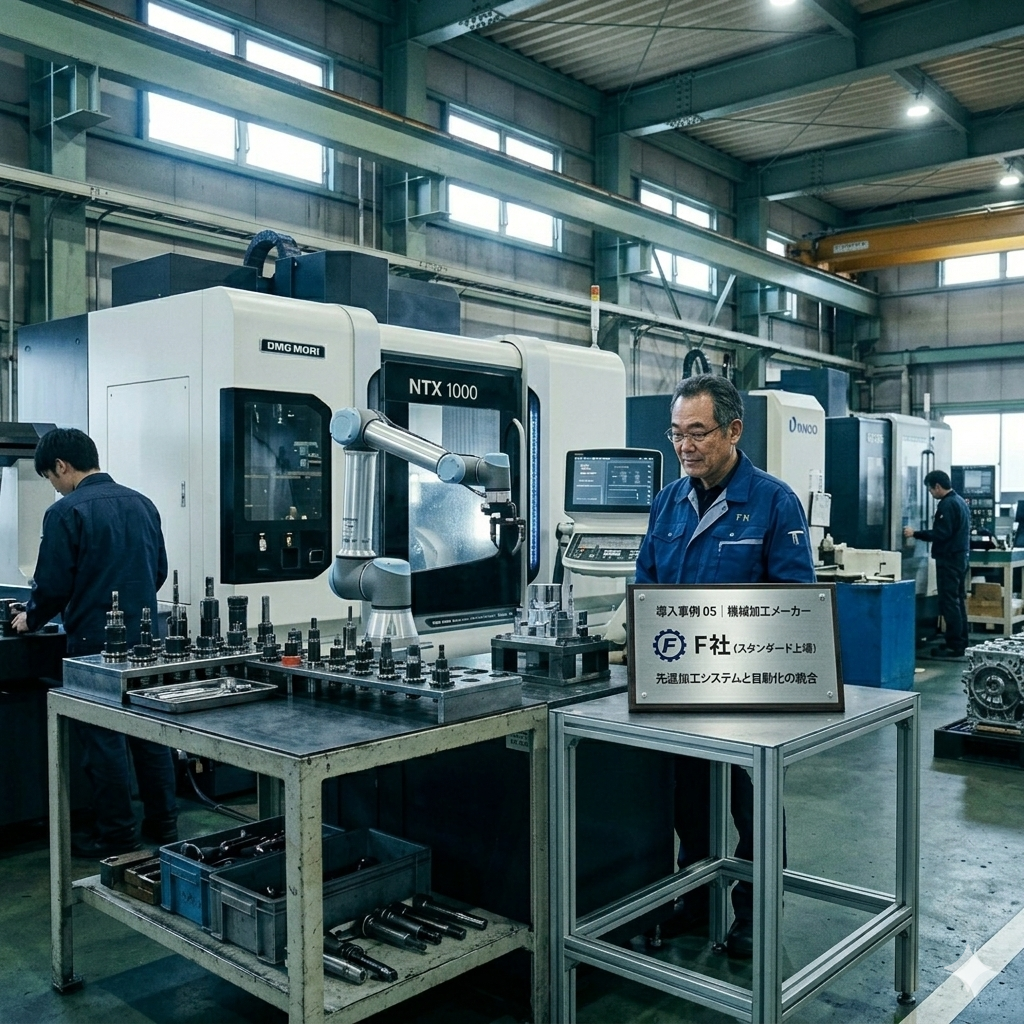
Case Study 06|Machining Manufacturer Company F (Standard Market Listed)
Centralizing high-mix, low-volume changeover know-how with AI. Average changeover time reduced by 41%.
Changeover time
Reduced by 41% on average
Setup completion rate
30% → 80%
Monthly production capacity
Up 17% YoY
Industry
Precision machining
Implementation scope
Entire shop floor and machining engineering department
Implementation period
4-week PoC → company-wide rollout in 3 months
Centralizing Changeover Know-How
Manufacturing Knowledge Base
Company F specializes in high-mix, low-volume production, so machine changeovers occur frequently.
However, knowledge about setup conditions, fixtures, and tool selection was concentrated among experienced operators, leaving new employees and support staff in a state where they could not complete changeovers without asking specific veterans.
As competition with large companies intensified, this mid-sized manufacturer introduced CLAVI Mining to eliminate both individual dependency and setup-time loss, strengthening its competitiveness.
Challenges Before Implementation
Changeover time varied widely from 30 minutes to 3 hours depending on the product type and machine. There was more than a twofold difference between work handled by experienced operators and work handled by new operators. Across the factory, changeovers occurred 22 times per day on average, and this variation directly affected monthly production capacity.
Setup conditions existed in paper work procedures and in the heads of experienced workers, while Excel files on shop-floor PCs were scattered by person and department. Searchability was effectively zero. In the past year, there were 38 cases across the factory where the same product's setup conditions could not be found, causing half a day to be lost through retrial.
It previously took 30 months for new employees to become independent. As employee retention declined, the shortage of people capable of performing changeovers became serious. As a mid-sized company with limited hiring power, quickly developing existing employees into productive contributors became the top management priority.
Reasons for Selection
REASON
01
As a mid-sized company, Company F needed to select an AI solution that shop-floor teams would actually use within a limited budget. General-purpose ChatGPT-style tools could not be used with confidential information, while industry-specific tools had limited adoption records. CLAVI Mining was highly rated for its track record of more than 1,600 customer implementations and its manufacturing-site-focused design.
REASON
02
In addition, patent-based prevention of incorrect answers was highly valuable for a mid-sized company because it supported accountability in the event of an incident. From a business continuity planning perspective as well, reducing dependence on veteran workers was a high-priority management issue.
REASON
03
During the PoC, three specific machining centers were selected. Two years of past setup records were loaded into the AI to verify whether new operators could retrieve appropriate setup conditions. As a result, the rate at which new operators could independently reach suitable conditions rose from 23% at the start of the PoC to 71% by the end, enabling a smooth decision to move to full deployment.
Effects After Implementation
EFFECT 1
Changeover time
Reduced by 41% on average. The ratio of setups that could be completed by operators other than veterans improved from 30% to 80%. Monthly production capacity increased by 17% compared with the same period of the previous year.
EFFECT 2
Setup mistakes
Reduced from 8 cases per month to 2 cases per month, a 75% decrease. Rework costs caused by inspection failures were significantly reduced. The annual reduction in rework labor was estimated at approximately ¥7.8 million.
EFFECT 3
Time for new employees to become independent
Shortened from 30 months to 14 months. As new employees became productive more quickly, the training burden on veteran employees was also greatly reduced.
EFFECT 4
Equipment utilization
By reducing setup-loss time, the monthly average utilization rate increased from 72% to 81%. Missed order opportunities decreased, creating additional capacity to respond to new customers.
Insights from This Case and Future Expansion
Company F's case shows the possibility that mid-sized companies can outperform large enterprises through the agility of AI implementation. In mid-sized companies, where decision-making is fast and management is close to the shop floor, completing the process from PoC to full operation in three to four months is a major strength. Compared with the long review periods typical of large companies, mid-sized companies can create competitive advantage through implementation speed.
In addition to using knowledge for changeovers, Company F is considering expansion into machining-condition optimization. By combining past trial-production data with quality results, the company aims to process parts under optimal conditions from the start. The combination of machining data and AI is becoming a core path for differentiation among mid-sized manufacturers.
There has also been a positive effect on hiring. Branding as a mid-sized company that makes the shop floor smarter with AI has led to more applications from young engineers. The combination of mid-sized-company speed and AI utilization is becoming a central driver of stronger competitiveness. Positioning as an advanced mid-sized company is also highly effective from a talent strategy perspective.
COMMENT
Factory Manager Comment
“Mid-sized companies can become stronger with AI. CLAVI is an AI vendor that understands the shop floor, so we were able to move from PoC to full operation within a realistic timeframe. Next, we are considering applying it to machining-condition optimization.”
EXECUTIVE NOTE
Additional Executive Comment
The management of mid-sized companies can outpace large enterprises through the speed of AI investment decisions. The agility to move from PoC to production operation within three to four months directly translates into competitiveness. This is a typical example of building competitive advantage for mid-sized companies through AI.