Turning molding condition-setting know-how into an asset with equipment-specific AI.
EQUIPMENT AI PROFILE
Equipment-Specific AI Implementation Info
Industry
Resin molding (automotive and home appliance parts)
Target area
Molding shop floor and mold engineering department
Implementation period
5-week PoC → 4-month rollout to all factories
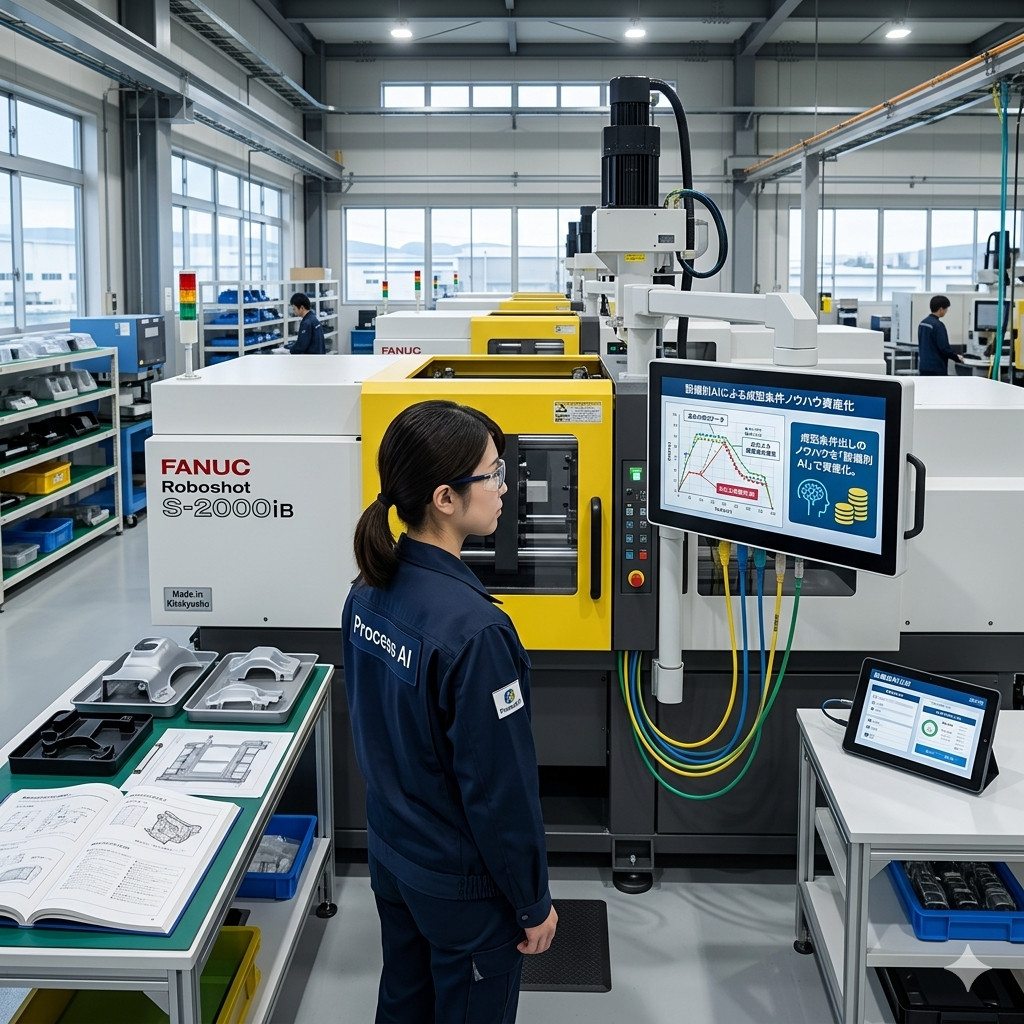
BACKGROUND
Turning condition-setting knowledge into AI assets
In the resin molding industry, quality depends heavily on “condition setting,” where combinations of temperature, pressure, speed, and cooling time are refined through trial production.
At Company I, condition setting depended on the tacit knowledge of experienced operators, creating challenges around veteran dependency and trial production costs.
As orders shifted toward smaller lots, the frequency of launching new molds increased, making the reduction of condition-setting costs a management issue directly tied to company-wide profitability.
With CLAVI Mining, the company accumulated equipment- and resin-specific condition-setting knowledge in AI and reduced the number of trial runs.
BEFORE
Challenges before implementation
ISSUE 01
When launching new molds, condition-setting trials were repeated an average of 7 to 10 times, with each trial incurring tens of thousands of yen in resin and labor costs. On an annual basis, trial costs alone exceeded 60 million yen, making profitability improvement the company’s biggest priority.
ISSUE 02
Molding-condition know-how was scattered across paper work reports, handwritten personal notes, and equipment-specific Excel files, making it impossible to search effectively. It often took more than half a day to find out what had been done with similar materials or equipment in the past, so the default approach on site was ultimately to “ask a veteran.”
ISSUE 03
When veteran operators left the shop floor, new launches stalled, and the long-standing structure of being unable to move forward without veteran backing had not been improved. Passing on the know-how of three skilled operators scheduled to retire had become a business-continuity-level priority.
WHY CLAVI
Reason for selection
SELECTION AXIS
Search accuracy and minimized burden on the shop floor
REASON 01
What Company I prioritized was search accuracy by equipment and conditions, along with eliminating the need for the shop floor to reorganize documents. CLAVI Mining clearly stood apart from other options because it could learn from past work reports and condition records as-is, while providing high search accuracy by equipment.
REASON 02
Another deciding factor was customer-success support that helped design an operation flow easy for the shop floor to register and maintain. In the molding industry, where a culture of maintaining manuals is not deeply rooted, UX design that accumulates knowledge while minimizing shop-floor burden was essential.
REASON 03
In the PoC, three years of past work reports were learned by the system, and the number of condition-setting trial runs was compared across three new orders. With AI assistance, the average number of trials fell to 4.2, a 41% reduction from the previous level, leading to an early decision for full-scale deployment.
AFTER
Results after implementation
IMPACT 01
34% reduction
[Trial runs] Average reduced from 7.2 to 4.8 runs (34% reduction). Trial costs per mold were significantly reduced, producing annual trial-cost savings on the scale of 25 million yen.
IMPACT 02
40% reduction
[Condition-setting lead time] Average reduced from 5.2 days to 3.1 days (40% reduction). Response speed for new orders improved, strengthening competitiveness in delivery-date responses to customers.
IMPACT 03
80%
[Veteran dependency] The organization shifted to a structure where 80% of new launches could be completed under the leadership of mid-level operators. Veterans could now spend more time on final launch decisions and accumulating new know-how.
IMPACT 04
AI assetization
[Know-how assetization] Although three skilled operators were approaching retirement, the company reached internal agreement that the condition knowledge accumulated in AI would remain as an organizational asset, ensuring operational continuity after retirement.
EXECUTIVE COMMENT
Comment from the Head of Mold Engineering: “The molding industry is built on craftsmanship. AI did not take craftsmanship away; instead, it served as support that allowed younger employees to reproduce expert judgment. As a result, we feel that the value of our experts has also increased.”
FIELD SURVEY
78%
In a shop-floor survey, more than 78% of respondents said that AI increased their confidence in their work, leading to a mindset shift across younger, mid-level, and veteran employees. This is a case where AI-driven workplace culture transformation is happening in a visible way.
INSIGHTS / NEXT
Insights from this case study and future expansion
CORE MESSAGE
Turning expert judgment into an organizational asset
STEP 01
What Company I’s case shows is the effectiveness of an approach that does not use AI to take craftsmanship away, but instead turns expert judgment into an organizational asset. Not only in the molding industry, but across many manufacturers seeking to move away from veteran dependency, the concept of using AI to enhance the value of veterans is becoming a strong option.
STEP 02
Company I is also considering expanding AI support for molding condition setting into mold maintenance operations. The goal is to train AI on mold wear and damage history, then predict appropriate maintenance timing.
STEP 03
The company has also begun using AI for technical consultation during customer meetings, improving both response speed and quality in the sales engineering department. The concept of expanding veteran judgment across the entire organization is spreading across business functions. The competitiveness of mid-sized manufacturers is entering the next stage through the combination of craftsmanship and AI.